
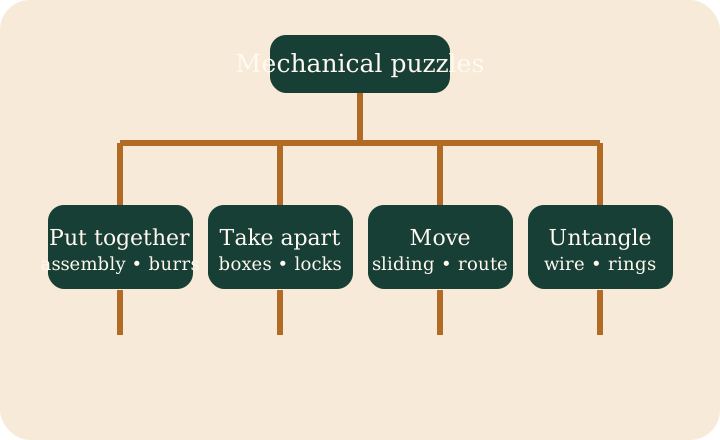
This family tree is a navigation aid rather than a literal genealogy. Puzzle types do not descend neatly from one another. Instead, the tree groups objects by the main challenge a solver encounters, following the principle used by modern mechanical-puzzle classifications.
Why a cube is not necessarily a “cube puzzle” family
Outward shape can mislead. A cube may be a packing puzzle, an interlocking burr, a sliding puzzle or a twisty permutation puzzle. The Puzzle Museum’s classification guidance explicitly recommends looking at the intended problem and internal construction rather than simply the finished shape.
Where Crafty Puzzles examples fit
Use the tree to identify an unknown puzzle
First ask what the solver is supposed to achieve. Then compare the object with the matching family in the mechanical puzzle encyclopaedia.
Sources and further reading
- The Puzzle Museum: Classification of mechanical puzzles
- The Puzzle Museum: A brief history of puzzles
- Fitzwilliam Museum: Mechanical puzzles terminology
Sources are linked for verification and further reading. Crafty Puzzles has written this article in its own words.