
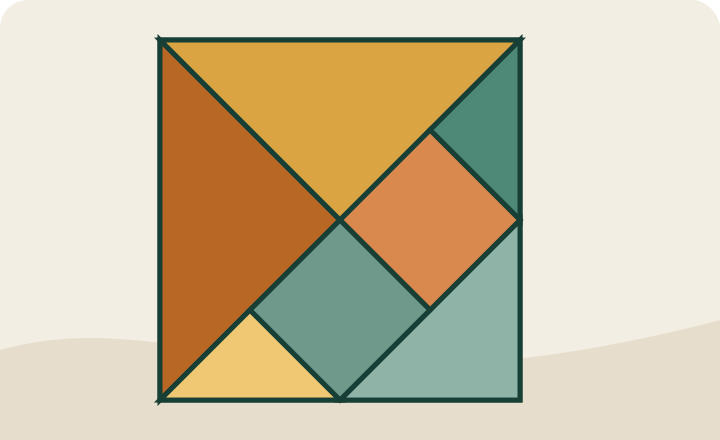
A dissection puzzle begins with a shape divided into pieces. The solver rearranges every piece, normally without overlap, to make a new target figure.
The Stomachion
The Stomachion, or Archimedes’ Box, is an ancient square divided into fourteen pieces. It demonstrates that the idea of rearranging geometric parts long predates the modern toy trade.
The seven-piece tangram
The tangram contains two large triangles, one medium triangle, two small triangles, a square and a parallelogram. It became a major puzzle craze in China around 1800 and spread quickly to Europe and North America during the early nineteenth century. Books presented silhouettes of people, animals, buildings and objects to reproduce using all seven pieces.
Why tangrams remain useful
Tangrams are simple to manufacture but support many levels of challenge. They develop visualisation, rotation, reflection and part-to-whole reasoning. The parallelogram is especially important because turning it over changes its handedness.
Modern relatives
Pentominoes, polyforms, packing puzzles and transformation puzzles all share the central idea of creating new wholes from fixed pieces. Unlike a jigsaw, the target may have no picture printed on the parts and may permit several valid solutions.
Try a related packing challenge
The Crafty Puzzles Pentomino Puzzle page includes an original checked 8 × 8 arrangement.
Sources and further reading
- Encyclopaedia Britannica: Tangram
- UNSW: The history and mystery of Tangram
- The Puzzle Museum: Sources in recreational mathematics
These sources are provided for historical verification and further reading. The article above is newly written for Crafty Puzzles.