
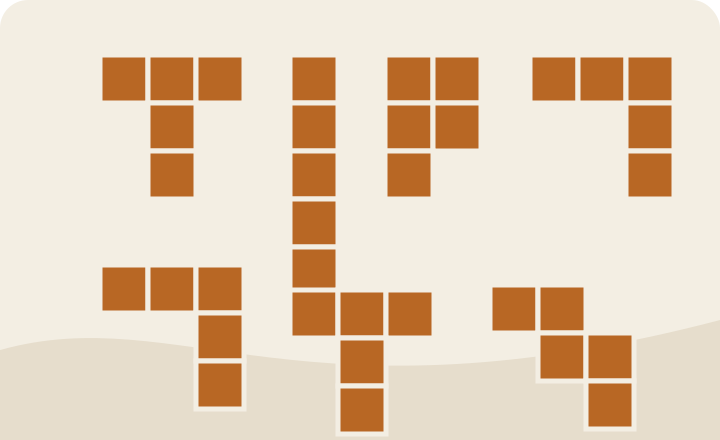
A pentomino is made from five equal squares joined edge to edge. Ignoring rotations and reflections, there are twelve different shapes, conventionally named after letters they resemble.
Solomon Golomb and the polyomino name
In 1953 the young mathematician Solomon W. Golomb presented polyominoes to the Harvard Mathematics Club and introduced the systematic names tromino, tetromino, pentomino and related terms. He later developed the subject in his book Polyominoes.
Earlier packing problems
Golomb created the terminology and a general mathematical framework, but related shape-packing challenges existed earlier. Henry Dudeney included a pentomino-style problem in The Canterbury Puzzles in 1907.
Why twelve pieces are so rich
The twelve pentominoes cover sixty unit squares in total. They can therefore form rectangles such as 6 × 10, 5 × 12, 4 × 15 and 3 × 20. An 8 × 8 square can be made by adding a separate 2 × 2 piece, as in the archived Crafty Puzzles set.
From recreational mathematics to games
Pentominoes became widely known through mathematical writing and puzzle columns. Their influence can be seen in later packing games and computer-search problems. They are simple enough to cut from card or wood, but difficult enough to support extensive mathematical investigation.
View the Crafty Puzzles 8 × 8 solution
Sources and further reading
- Andrews University: Pentominoes and their history
- Springer: Pentominoes and Similar Puzzles
- Stephen Wolfram: Solomon Golomb, 1932–2016
These sources are provided for historical verification and further reading. The article above is newly written for Crafty Puzzles.