
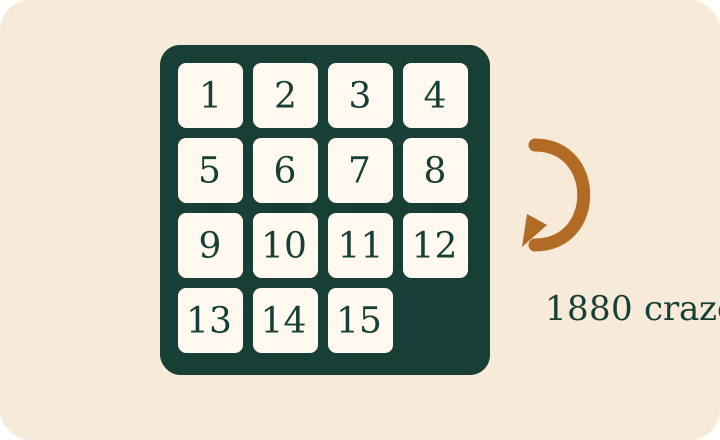
Few mechanical puzzles demonstrate the power of a simple rule as clearly as the 15 Puzzle. Fifteen numbered tiles sit in a four-by-four frame with one space left empty. A legal move slides one adjacent tile into the gap. From that rule comes a puzzle that became an international craze and later a classic example in recreational mathematics and computer search.
Noyes Chapman and the puzzle’s origins
For many years the 15 Puzzle was popularly associated with American puzzle writer Sam Loyd. Historical research by Jerry Slocum and Dic Sonneveld instead traced the design to Noyes Palmer Chapman, a postmaster in Canastota, New York. Chapman is reported to have shown a precursor to friends as early as 1874. By late 1879 versions of the sliding puzzle were being manufactured, and the craze erupted in the United States in January 1880 before spreading to Europe that spring.
The Sam Loyd story
Loyd later claimed the puzzle as his own invention, but modern histories reject that attribution. His enduring connection to the 15 Puzzle comes partly from the famous challenge in which tiles 14 and 15 are exchanged. It looks tantalisingly close to the solved arrangement, yet that state cannot be reached from the standard solved position using legal moves.
Why some arrangements are impossible
The puzzle has a hidden mathematical restriction. Legal moves preserve a parity condition, which means the apparent universe of tile arrangements splits into two classes. Only one class is reachable from a given starting state. That mathematical fact explains why swapping just two numbered tiles can create a configuration that no amount of sliding will solve.
From wooden tiles to digital search
The sliding-puzzle idea outlived the original craze. Picture sliders, letter puzzles and increasingly complex sliding-block problems all use the same general principle: every move changes which moves become possible next. This is why modern classifications place them within sequential-movement puzzles. The same state-space structure also makes sliding puzzles natural subjects for algorithms and artificial-intelligence search.
Try the mechanism yourself
Crafty Puzzles includes a browser version of the classic challenge. Playing it makes the historical appeal easy to understand: the rules take seconds to learn, but planning several moves ahead is much harder.
Sources and further reading
- Wolfram MathWorld: 15 Puzzle
- Indiana University Lilly Library: Sequential-movement puzzles
- The Puzzle Museum: A brief history of puzzles
Sources are linked for verification and further reading. Crafty Puzzles has written this article in its own words.