
Puzzle guide
How to Read Old Puzzle Assembly Diagrams
Learn how component keys, arrows, colour highlights, turnover symbols and numbered stages work in puzzle instructions.
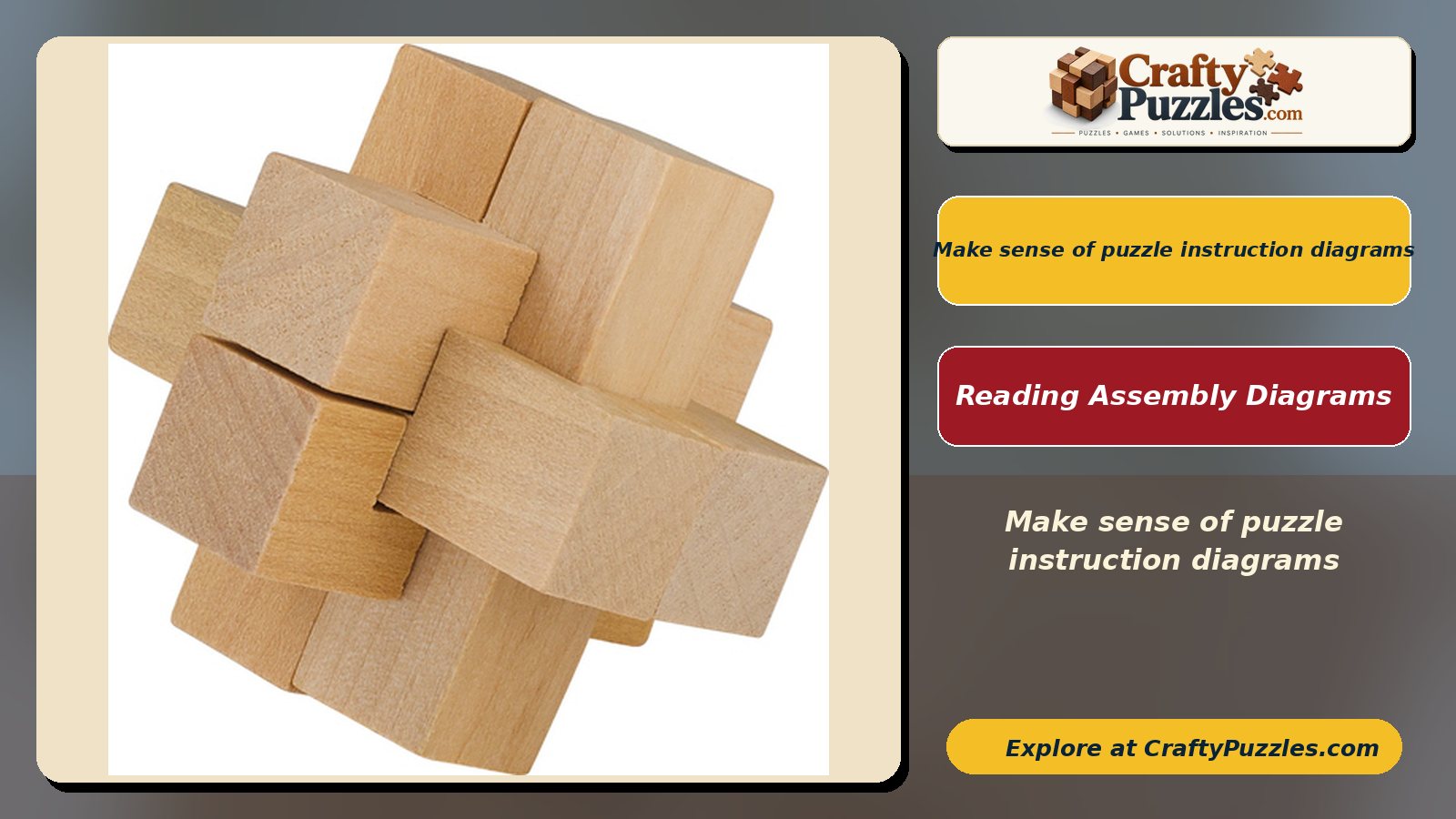
Older puzzle sheets often rely on diagrams rather than text. Begin with the component key, which identifies repeated pieces and shows the viewing angle used throughout the instructions.
Follow the highlighted piece
Many diagrams colour the piece being added while previously assembled pieces remain neutral. An arrow shows the direction of travel, not always the final orientation.
Watch for turnover symbols
A curved arrow around the whole assembly means rotate or turn over the entire structure before continuing. Keep fitted pieces in place during this move.
Compare before and after
At each stage, compare the empty channels and outside silhouette with the next image. If a channel is missing, an earlier piece is likely reversed.
All solution diagrams on Crafty Puzzles can now be opened in a zoomable full-screen viewer.
Three things an old assembly diagram may leave implicit
Archive instructions often assume that the reader already knows how the pieces are oriented. Before copying a drawing, choose a fixed “front” face and keep it consistent. A piece that appears to move sideways in one frame may actually have been rotated between drawings.
1. Hidden depth
A two-dimensional drawing cannot always show whether a bar passes in front of, behind or through the centre of another piece. Use visible notch positions and the completed photograph to infer depth before pushing pieces together.
2. Temporary looseness
Interlocking puzzles are frequently assembled with several parts deliberately loose. If a diagram shows a new piece entering a structure that already looks tight, back up and create a little clearance rather than forcing it.
3. The locking move
The final picture may hide the one movement that turns a loose construction into a stable puzzle. Look for arrows, shaded pieces or a changed notch position between the last two frames. When a diagram is ambiguous, compare the relevant burr guide and the general assembly workflow.